Chapter 03Fit · System
Holiday lights plan: measure the front, buy once, label every set
Sketch the front from across the street and name each run. Measure every run from the ground, add 10% and divide by the lit length on the box to get the sets. Before you buy, read the label for indoor or outdoor use and the most sets the maker lets you connect. Test each set on the ground and hang it with clips. When the lights come down, tag each set with its run and box number, and next year follows the same plan.
Source: Christmas Light Emporium, rooflines and gables, checked October 9, 2026; Christmas Light Emporium planning guide, checked October 9, 2026; NFPA Winter Holiday Safety tip sheet, checked October 9, 2026.
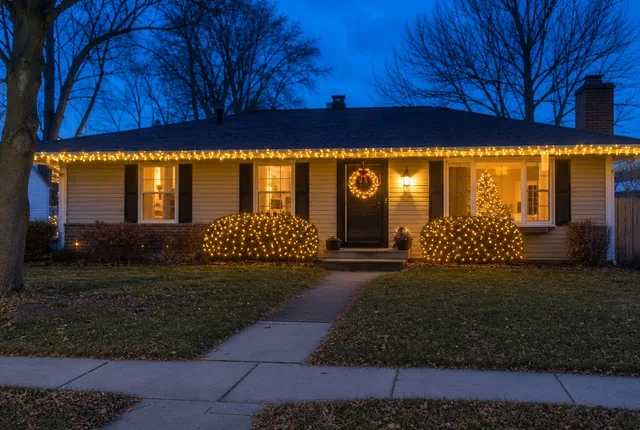
- Slack on each roofline, window and door run+10% Christmas Light Emporium planning guide, October 9, 2026
- Sets you can connect end to end: read the maker's number (NFPA)The tag NFPA Winter Holiday Safety tip sheet, October 9, 2026
- Run name and box number, tied on when the set comes down1 tag per set Counted from this page
Do it, skip it or get help
Plan it yourself
Measuring from the ground and reading the box takes an afternoon, and the calculator does the arithmetic. The Christmas Light Emporium says to measure every roofline and gable edge from the ground. The plan sheet is yours either way, even if someone else hangs the lights.
Source: Christmas Light Emporium, rooflines and gables, checked October 9, 2026.
Skip what you won't light
No gable on the front? Skip the rise. Lighting only the windows and the door? Skip the roofline and leave the eaves at zero. Keep the take-down tags either way; they make next year faster.
Get help for ladders, roofs and outlets
If hanging the run means climbing onto the roof or working at a high gutter, and that isn't a job you do, hire a light installer and hand them the plan sheet. Read the label on each cord and set. Any outlet work goes to a licensed electrician where the law requires one.
The steps, in order
Sketch the front and name each run
Stand across the street and draw the house on one sheet. Mark where each run starts and ends: the eaves, each gable, every window you want lit, the door, the rail. Give each run a name and a number.
Have ready: The plan sheet, a pencil, a clipboard
Source: Christmas Light Emporium, rooflines and gables, checked October 9, 2026.
Measure each run from the ground
Mark the ground under each gutter corner and tape from mark to mark for the eaves. For a gable, tape the width at the eaves and count siding rows for the rise. Windows take their perimeter, the door its two sides and top.
Have ready: A long tape measure, chalk or a few stones
Source: Christmas Light Emporium, rooflines and gables, checked October 9, 2026; Christmas Light Emporium planning guide, checked October 9, 2026.
Work out the sets for each run
Add 10% to each run and divide by the lit length on the box, rounding up. A window or a door is a run of its own, because a set can't be cut to share. The calculator does this and the gable edges for you.
Have ready: The measurements and the calculator
Source: Christmas Light Emporium planning guide, checked October 9, 2026.
Read the box and the tag before you buy
Check the lit length, not the total length. NFPA says some lights are only for indoor or outdoor use, but not both, so read that line. Then read the maker's instructions for how many sets you can connect, and write that number on the sheet. It sets how many runs start at their own cord.
Have ready: The plan sheet in the store or a product page open
Source: NFPA Winter Holiday Safety tip sheet, checked October 9, 2026; 1000Bulbs holiday lighting guide, checked October 9, 2026.
Test each set on the ground
Plug each set in on the ground before it goes up. NFPA says to replace any string with worn or broken cords or loose bulb connections, so a set that fails here gets thrown out before it goes up. Lay each run out on the lawn in order.
Have ready: The sets, out of their boxes
Source: NFPA Winter Holiday Safety tip sheet, checked October 9, 2026; Christmas Light Emporium, rooflines and gables, checked October 9, 2026.
Hang with clips and write the start points
NFPA says to use clips, not nails, so the cords don't get damaged. Hang each run as the sketch shows, then write on the sheet where each run starts and which cord feeds it.
Have ready: Clips counted for each run
Source: NFPA Winter Holiday Safety tip sheet, checked October 9, 2026.
Decide who switches them off at night
NFPA's holiday tip sheet says to turn off all light strings and decorations before leaving home or going to bed. Write down who does it each night, or the time a timer you already own is set to.
Have ready: A line on the sheet
Source: NFPA Winter Holiday Safety tip sheet, checked October 9, 2026.
Take down, tag and box by run
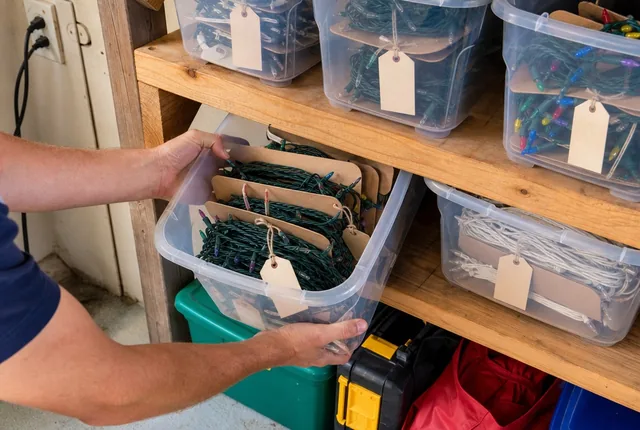
NFPA says to bring outdoor electrical lights inside after the holidays. As each set comes down, tie a tag on the plug end with the run name, wrap it, and put each run in its own numbered box. Write the box numbers, the date down and any failed sets on the sheet.
Have ready: Tags, a marker, boxes or bags
Source: NFPA Christmas Tree Safety tip sheet, checked October 9, 2026.
Print the working copy
One page, black and white, US Letter. Tick the boxes and write the dates in.
- Front sketched from across the street
- Each run named and numbered on the sketch
- Eaves taped between ground marks
- Gable widths and rises written down
- Windows, door, rail, bushes, tree sized
What goes wrong
Every run comes up a few feet short
The plan used the total length on the box. One 50-light mini set is 17.5 ft total but only 16.25 ft lit, because the lead and tail carry no bulbs. Plan with the lit length.
Source: Christmas Central 50-light LED mini set listing, checked October 9, 2026.
The gables weren't counted
Only the straight eaves were measured. A gable 24 ft wide that rises 6 ft adds 26.8 ft of sloped edge. In the worked example that is one more 25 ft set.
Too many sets on one cord
The long roofline was planned as one run from one plug. NFPA says to read the maker's instructions for how many strands to connect; past that number, the run needs a second starting point. Mark it on the sketch before you buy cords.
Source: NFPA Winter Holiday Safety tip sheet, checked October 9, 2026.
Indoor lights on the outside
A box from the attic gets hung on the porch without anyone reading the label. NFPA says some lights are for indoor or outdoor use only. Write the label wording on each set's tag.
Source: NFPA Winter Holiday Safety tip sheet, checked October 9, 2026.
Next year starts from scratch
Everything went into one box with no tags, so nobody knows which set goes where or which one failed. The run tag and the box number fix this in a few minutes at take-down.
When the steps change
Ranch with no gable
One long eaves run, maybe a side run you can see from the street. Leave the gable rows blank and check the tag number against that one long run.
Windows and door only
The roof stays dark. Each window, the door and the rail is its own run with its own starting point, so the plan sheet has more rows and the shopping list is all smaller sets.
Two-story front with matching gables
Measure one gable and count the matching ones. A smaller dormer is a separate run with its own width and rise. Ladder work at that height is the usual point to hire an installer.
Renting
Ask the landlord before clipping anything to the gutter or trim, and write down what you agreed. The plan sheet and the tagged boxes move with you.
Tips and tricks
- Tip 01
Measure in early November
Do the ground marks on a dry afternoon, a few weeks before the lights go up. Leave the chalk marks until the lights are up so you can check a run against the plan.
- Tip 02
One product per run
Sets from different boxes can differ in bulb spacing and color. Buy every set for one run in one order, from the same product.
- Tip 03
Photograph the first night
Take one photo of the house lit from across the street. Print it small and tape it to the plan sheet; it shows next year's helper what goes where.
- Tip 04
Keep the receipt in the box
ENERGY STAR certified light strings come with a warranty of at least three years. Tape the receipt inside the box lid so the date is there if a set fails early.
Source: ENERGY STAR decorative light strings, checked October 9, 2026.
- Tip 05
Tag on the plug end
Tie the tag where the plug is. The plug end is the start of the run, so the set goes up the right way round next year.
What we would do
Plan the front once, then reuse it every year
Spend one afternoon in early November measuring from the ground and filling in the plan sheet. Buy each run's sets in one order, test them on the lawn, and hang them with clips. At take-down, tag each set by run and box it by run. Next year, open the binder, check the failed-set list, and the lights go up from the same sheet.
The tools and guides in this system
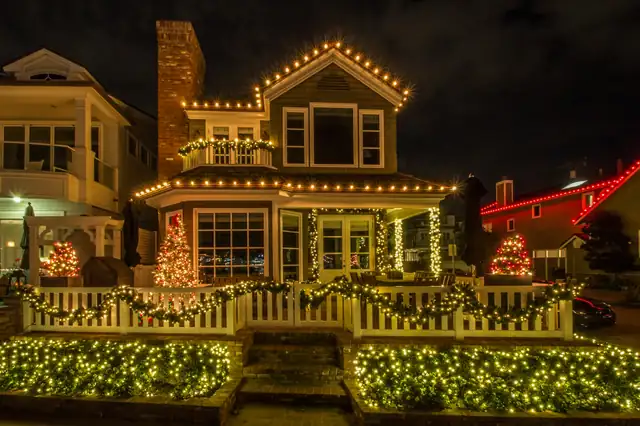 Chapter 03Holiday light length calculatorMeasure the roofline from the ground, add the gable edges and 10%, and get the feet, the sets, the plug points, nets for the bushes and lights for the tree.Open the tool
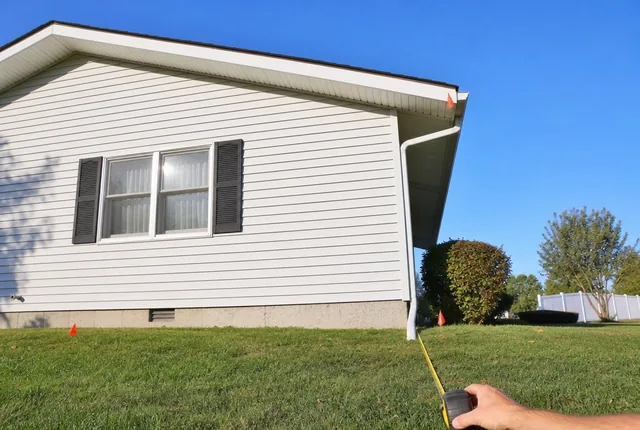 Know-howHow to measure a roofline for lights from the groundMark the ground under each gutter corner, tape the eaves, then work out each gable's sloped edges from its width and rise. No ladder needed.Read the guide
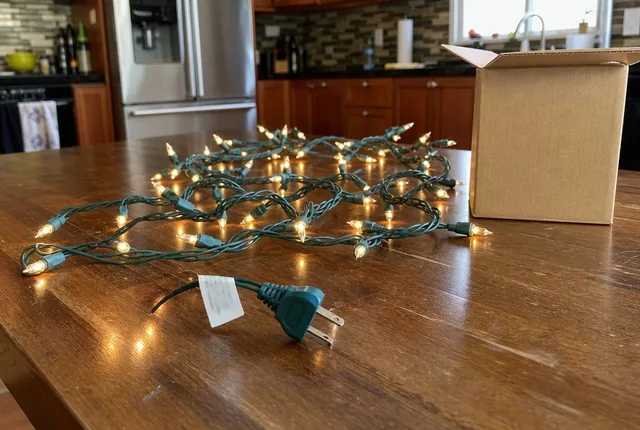 Know-howLit length, lead length and sets end to end: reading the boxWhy a 17.5 ft light set only lights 16.25 ft, how to find the lit length when the box hides it, and where to read how many sets connect end to end.Read the guide
- Chapter 03All fit toolsMeasuring tools for furniture: a doorway and hallway fit check, a bed size check for the room, and a printable sheet for every door and turn.Open the chapter
Questions
How do I plan Christmas lights for my house?
Sketch the front, name each run, measure each one from the ground, add 10% and divide by the lit length on the box. Read the tag for how many sets connect, which tells you how many starting points each run needs. Write it all on one sheet.
Source: Christmas Light Emporium planning guide, checked October 9, 2026; Christmas Light Emporium, rooflines and gables, checked October 9, 2026.
How do I store Christmas lights so they don't tangle?
Store them by run, not by type. Tie a tag on the plug end with the run name, wrap each set on its own, and put each run in a numbered box. Write the box numbers on the plan sheet.
When should I take down outdoor Christmas lights?
After the holidays. NFPA's tree tip sheet says to bring outdoor electrical lights inside after the holidays, to prevent hazards and make them last longer. Write the date down on the plan sheet.
Source: NFPA Christmas Tree Safety tip sheet, checked October 9, 2026.
How many strands of lights can I connect together?
The number the maker gives in the instructions or on the tag of that set. NFPA says to read the manufacturer's instructions for it; 1000Bulbs says it is usually 3 on the sets it describes, but sets differ.
Source: NFPA Winter Holiday Safety tip sheet, checked October 9, 2026; 1000Bulbs holiday lighting guide, checked October 9, 2026.
What should a holiday lights plan include?
A sketch of the front with each run named, the length of each run, the lit length and number of sets for it, the most sets end to end from the tag, where each run starts, the box number it is stored in, and the sets that failed.
The primary source
Winter Holiday Safety (safety tip sheet), National Fire Protection Association (NFPA). Checked October 9, 2026.
The steps on this page follow this source. Other figures cite their own source where they appear.
Other sources on this page
- The Architecture Of Light: Outlining Rooflines And Gables With Precision, The Christmas Light Emporium. Checked October 9, 2026.
- How Many Christmas Lights Do You Need? A Planning Guide, The Christmas Light Emporium. Checked October 9, 2026.
- Holiday Lighting Guide, 1000Bulbs.com. Checked October 9, 2026.
- Christmas Tree Safety (safety tip sheet), National Fire Protection Association (NFPA). Checked October 9, 2026.
- LED Mini Christmas Lights - Purple - 16.25' White Wire - 50ct (Northlight NL02532), Christmas Central. Checked October 9, 2026.
- Decorative Light Strings, ENERGY STAR (U.S. EPA). Checked October 9, 2026.
See every source on the site on the sources page. Spotted an error? Tell us.