Chapter 05Calendar · Tool and printable record
Home maintenance calendar by climate region
Every month, press the test button on each smoke and CO alarm and look at the HVAC filter. In spring, around the time the clocks go forward, book the cooling check-up and read the date on the back of each smoke alarm. In fall, around the time the clocks go back, book the heating check-up and put new batteries in alarms that take them. Before the first freeze, take the hoses off and drain the outdoor faucets. Your climate region decides whether the freeze jobs belong on your calendar at all.
Source: NFPA, installing and maintaining smoke alarms, checked October 15, 2026; NFPA, carbon monoxide safety, checked October 15, 2026; ENERGY STAR maintenance checklist, checked October 15, 2026; USFA, Don't wait, check the date handout, checked October 12, 2026; American Red Cross, frozen pipes, checked October 6, 2026; DOE Building America climate regions by county, checked October 13, 2026.

Home maintenance calendar
Result 8 dated jobs over 12 months, plus 2 monthly checks
- Climate region
- Cold
- First jobs
- November 2026
- Busiest month
- November 2026 (3 jobs)
Every month
- Press the test button on every smoke and CO alarm.
- Look at the HVAC air filter; clean or change it if it is dirty.
Month by month
- November 2026Clocks go back November 1
- Book the heating check-up with a contractor.
- Put a new battery in every smoke alarm that takes one. Sealed 10-year alarms are left alone.
- Gather supplies for several days at home without power, and write down where they are kept.
- March 2027Clocks go forward March 14
- Book the cooling check-up with a contractor.
- Read the date on the back of each smoke alarm. Any alarm 10 years past that date gets replaced.
- September 2027
- Book the chimney cleaning and inspection before the first fire of the season.
- Before the first freeze: disconnect, drain and store the hoses, close the inside valves to the outdoor faucets and open the outside faucets to drain. October freeze assumed: move it if yours comes later
- October 2027
- Do the paper test on each window and door, and write down the ones that leak.
Home: ____________________ · Climate region: Cold · Year starting: November 2026
| Month | Jobs this month | Every month | Done on |
|---|---|---|---|
| November 2026 Clocks go back November 1 | Book the heating check-up with a contractor. Put a new battery in every smoke alarm that takes one. Sealed 10-year alarms are left alone. Gather supplies for several days at home without power, and write down where they are kept. | alarms tested filter looked at | |
| December 2026 | Monthly checks only | alarms tested filter looked at | |
| January 2027 | Monthly checks only | alarms tested filter looked at | |
| February 2027 | Monthly checks only | alarms tested filter looked at | |
| March 2027 Clocks go forward March 14 | Book the cooling check-up with a contractor. Read the date on the back of each smoke alarm. Any alarm 10 years past that date gets replaced. | alarms tested filter looked at | |
| April 2027 | Monthly checks only | alarms tested filter looked at | |
| May 2027 | Monthly checks only | alarms tested filter looked at | |
| June 2027 | Monthly checks only | alarms tested filter looked at | |
| July 2027 | Monthly checks only | alarms tested filter looked at | |
| August 2027 | Monthly checks only | alarms tested filter looked at | |
| September 2027 | Book the chimney cleaning and inspection before the first fire of the season. Before the first freeze: disconnect, drain and store the hoses, close the inside valves to the outdoor faucets and open the outside faucets to drain. | alarms tested filter looked at | |
| October 2027 | Do the paper test on each window and door, and write down the ones that leak. | alarms tested filter looked at |
These are dates to book, look and write down. The work itself belongs to a contractor, the landlord or the equipment manual, and their schedule wins over this one.
How to use this, in plain words
Look up your county in the DOE climate region list (linked in the sources) and pick that region. Not sure yet? Pick "Not sure yet" and fix it later.
Say whether you own or rent. Renters get questions for the landlord instead of visits to book.
Tick what the home has: furnace, central air, the filter, a chimney or stove, septic, outdoor faucets, battery smoke alarms.
Set the start date and, if you know it, the month the first hard freeze usually comes. Pick a hurricane season if you live on a coast.
Print the year sheet and hang it near the calendar you already use. Tick each job and write the date you did it.
Before you start
- Note 01
Check the alarms you actually have
Sealed long-life alarms never get a new battery; the ones with a battery door do. Look at one before you tick the battery box.
- Note 02
Find the filter slot first
If you don't know where the HVAC filter lives, the filter size finder walks you through the usual spots. If the home has no filter, leave that box unticked.
- Note 03
Ask a neighbor about the first freeze
Someone who has lived on the street a few winters usually knows the month. It beats the tool's October guess.
- Note 04
Read the lease if you rent
Leases often say who changes filters and batteries. Match the renter calendar to what yours says.
How it works
- Two checks every month: test each smoke and CO alarm with its test button, and inspect, clean or change the air filter in a furnace, central air conditioner or heat pump.
- Spring: the cooling check-up is booked in March, the month the clocks go forward (second Sunday of March). Fall: the heating check-up is booked in November, the month the clocks go back (first Sunday of November). ENERGY STAR suggests planning check-ups around the time changes.
- Smoke alarms: read the date on the back in March and replace any alarm 10 years past it; put a new battery in alarms that take one in November.
- Freeze jobs (hoses off and drained, a winter supply list) go in by default for the mixed-humid, mixed-dry, marine, cold, very cold and subarctic regions, where the DOE region definitions put the coldest months below 45 F on average or the heating degree days above 5,400. Hot-dry and hot-humid homes get them only if you pick a freeze month.
- Hoses go in the month before your first hard freeze. If you don't know that month, the tool assumes October and puts the hoses in September. That October default is this tool's own choice.
- Chimney in September, the draft test in October and the septic look-up in April are this tool's own month choices; the sources say each year, before the heating season or every few years without naming a month.
- Hurricane reminder: two weeks before the season opens, which puts it in May for the Atlantic (June 1), Eastern Pacific (May 15) and Central Pacific (June 1) seasons.
Source: NFPA, installing and maintaining smoke alarms, checked October 15, 2026; NFPA, carbon monoxide safety, checked October 15, 2026; ENERGY STAR maintenance checklist, checked October 15, 2026; NIST, daylight saving time rules, checked October 12, 2026; USFA, Don't wait, check the date handout, checked October 12, 2026; DOE Building America climate regions by county, checked October 13, 2026; American Red Cross, frozen pipes, checked October 6, 2026; Ready.gov, winter weather, checked October 6, 2026; USFA heating fire safety, checked October 11, 2026; ENERGY STAR, seal behind window and door trim, checked October 9, 2026; EPA How to care for your septic system, checked October 11, 2026; Ready.gov, hurricanes, checked October 12, 2026.
Worked example
An owned house in the cold region with a furnace, central air, a filter in the return, a wood stove, two outdoor faucets and smoke alarms that take a 9-volt battery. No septic. The owners don't know the month of the first hard freeze. Calendar starts November 1, 2026.
- Cold region, owner, calendar starting November 2026. Clocks go back November 1, so the heating check-up, the smoke alarm batteries and the winter supply list all go in November 2026.
- March 2027: clocks go forward march 14. Book the cooling check-up and read the date on the back of each smoke alarm.
- September 2027: book the chimney cleaning before the first fire. The first freeze month isn't known, so the tool assumes October and puts the hoses in September 2027 too.
- October 2027: the paper test on windows and doors.
- Every month: test the alarms and look at the filter. That makes 8 dated jobs plus 2 monthly checks, 32 ticks on the year sheet.
If the answer surprises you
Most months are empty
Yearly jobs bunch up around the spring and fall time changes and the first freeze. The other months carry only the two monthly checks.
The heating check-up lands in November, not September
The tool follows the ENERGY STAR cue of booking around the fall time change. If your contractor fills up early, book it in September instead and move the tick.
Source: ENERGY STAR maintenance checklist, checked October 15, 2026.
Hoses in September when you live up north
With no freeze month picked, the tool assumes the first hard freeze in October. Set your own month and the row moves.
What to record
The year sheet has one row per month, from the month you start, with these columns. Print it from the tool, or print a blank sheet and fill it in by hand.
- Month (and the time change, when it falls in that month)
- Jobs this month, each with a tick box
- Every month: alarms tested, filter looked at
- Done on (date)
Variants
If you rent
Pick "We rent". Booking jobs turn into questions for the landlord, the septic row comes off, and the freeze row asks who closes the inside valves. The alarm tests and the filter check stay, because you live with them every day.
Hawaii and most of Arizona
Untick the time change box. The spring and fall jobs stay in March and November, without the clock dates, since these places don't change the clocks.
Source: NIST, daylight saving time rules, checked October 12, 2026.
Hurricane coasts
Pick your season and a May reminder appears to read Ready.gov's hurricane page and check your supply list before the season opens.
Source: Ready.gov, hurricanes, checked October 12, 2026.
Not sure of your region
Pick "Not sure yet". The calendar keeps the freeze jobs in so nothing is missed, and the DOE county list gives the region for every county.
Source: DOE Building America climate regions by county, checked October 13, 2026.
Numbers this tool uses
- Smoke and CO alarm testAt least once a month NFPA, installing and maintaining smoke alarms, October 15, 2026
- HVAC air filterInspect, clean or change once a month ENERGY STAR maintenance checklist, October 15, 2026
- Smoke alarm replacement10 years from the date on the back USFA, Don't wait, check the date handout, October 12, 2026
- Clocks go forward / backSecond Sunday of March / first Sunday of November NIST, daylight saving time rules, October 12, 2026
- Hot-dry regionMonthly average stays above 45 F all year DOE Building America climate regions by county, October 13, 2026
- Atlantic hurricane seasonJune 1 to November 30 Ready.gov, hurricanes, October 12, 2026
Limitations
- Planning estimate; check the manufacturer's manual and your contractor's or landlord's schedule, which win over these months.
- The calendar says when to book, look and write down. It does not say how to service a furnace, chimney, septic tank or faucet, or whether anything is working. A licensed contractor or the landlord does that work.
- The first freeze month is yours to set. The tool has no frost data; the October default is only there so the hoses row is not forgotten.
- A county sits in one region on the DOE map, but a house on a hill or by the coast can run colder or warmer than its county.
Tips and tricks
- Tip 01
Put the two time changes in your phone
The spring and fall dates carry most of the yearly jobs. One reminder on each date covers them.
Source: NIST, daylight saving time rules, checked October 12, 2026.
- Tip 02
Keep the year sheet with the service log
When you book a check-up, write the visit on the home service log the same day, so the next due date is ready.
- Tip 03
Same day every month
Pick the first Saturday for the alarm test and filter check. A fixed day is easier to keep than "sometime this month".
What we would do
Print it, then put two reminders in your phone
Make the calendar, print the year sheet and hang it where you see it. Add a phone reminder for each time change; those two days carry most of the year's booking.
Questions
Which climate region am I in?
The Department of Energy's Building America guide lists every US county with its region: hot-humid, hot-dry, mixed-humid, mixed-dry, marine, cold, very cold or subarctic. Find your county in the list and pick that region in the tool.
Source: DOE Building America climate regions by county, checked October 13, 2026.
What should I do around the house every month?
Two things. Press the test button on each smoke and CO alarm, and look at the HVAC air filter, cleaning or changing it if it's dirty.
Source: NFPA, installing and maintaining smoke alarms, checked October 15, 2026; NFPA, carbon monoxide safety, checked October 15, 2026; ENERGY STAR maintenance checklist, checked October 15, 2026.
When should I book the furnace and AC check-ups?
ENERGY STAR suggests the cooling check-up in spring and the heating check-up in fall, planned around the time changes, because contractors get busy once summer and winter arrive. The tool puts them in March and November.
Source: ENERGY STAR maintenance checklist, checked October 15, 2026; NIST, daylight saving time rules, checked October 12, 2026.
I rent. Which jobs are mine?
The alarm tests and the filter check usually are, and so are taking the hoses off and writing down drafty windows. Heating, cooling, chimney and septic visits are booked by the landlord, so the renter calendar turns those into questions to ask. Your lease decides.
Why are there no freeze jobs on my calendar?
They are left off by default in two regions. The DOE guide defines hot-dry as a place where the monthly average stays above 45 F all year, and hot-humid as the warm, moist south below its "warm-humid" line. If your area does freeze, pick the month of the first hard freeze and the rows come back.
Source: DOE Building America climate regions by county, checked October 13, 2026.
Does the tool save my calendar?
No. It is rebuilt from the form each time and nothing leaves your browser. Print the year sheet or save it as a PDF from the print dialog.
Part of a system
This page is one part of a bigger job. The system page puts the parts in order.
 SystemGutter and downspout recordOne page for your gutters: measure each run from the ground, check the size and downspout count, book spring and fall cleanings, note every spill.8 steps · 5 parts · 1 page to printOpen the system
 SystemMonthly house checkOne page for the monthly house check: test each smoke and CO alarm, look at the filter, read the water meter, check under the sinks, write one line.8 steps · 7 parts · 1 page to printOpen the system
 SystemSeasonal home calendar for your climate regionFind your county's climate region, then set up a 12-month home calendar: two checks a month, spring and fall bookings, and freeze jobs only where it freezes.9 steps · 3 parts · 1 page to printOpen the system
 SystemSpring home checklist and leak-check recordThe spring list for a US home on one printable page: book the cooling check-up, date and test every alarm, check the filter, run the two-hour leak check.9 steps · 6 parts · 1 page to printOpen the system
 SystemStorm and outage prep recordOne record for the next storm: count water and food by people and days, list what needs power, write contacts on paper, date the kit and check it yearly.9 steps · 5 parts · 1 page to printOpen the system
 SystemSummer cooling-season recordOne printable page for the cooling season: the AC model and age, the spring check-up, a filter date each month, hot rooms and bills to show the contractor.8 steps · 7 parts · 1 page to printOpen the system
Guides that go deeper
- Practical noteBooking the cooling check-up: what to have ready before you callBook the spring AC check-up with the system's model, its service history and the rooms that run hot in front of you. Then write the date down.Read the guide
- Practical noteThe spring time change list: four house jobs for the weekend the clocks go forwardWhat to do the weekend the clocks go forward: book the cooling check-up, read each smoke alarm's date, test every alarm and look at the HVAC filter.Read the guide
- Practical noteThe monthly walk: a 10-minute house check with one line to write downA 10-minute monthly house check: test each smoke and CO alarm, look at the HVAC filter, read the water meter, look under the sinks and write one line.Read the guide
Related tools
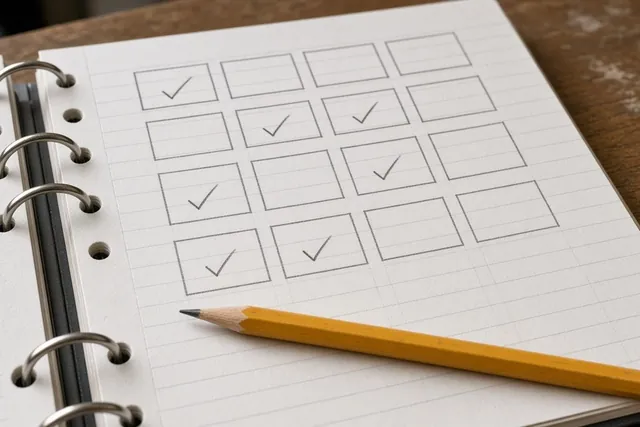 Chapter 01Home service logTurn the last visit for your heating, cooling, chimney and septic service into the next due date and a book-by date, then print a log of who to call.Open the tool
 Chapter 01HVAC filter size finder and replacement plannerTurn a nominal size like 16x25x1 into the filter's actual dimensions, or measure an old filter to find the size to buy, then plan the next change.Open the tool
 Chapter 01Smoke and CO alarm plannerCount smoke and CO alarms level by level from NFPA's placement list, then get the replace-by date and the next battery change for your alarms.Open the tool
 Chapter 01Appliance and warranty logRecord each appliance's model number, serial number and purchase date, see which warranty ends next, and print a one-page log for the drawer.Open the tool
 Chapter 04Utility transfer checklistEnter your move-out and move-in dates. Get the last day to call electric, gas, water, trash and internet, the meter days, and a utility list to print.Open the tool
 Chapter 01Gutter and downspout sizingMeasure a gutter run and its roof from the ground, apply the pitch factor, and get the gutter size, downspout count and slope, plus a printable gutter log.Open the tool
- Chapter 05Outage supply plannerCount the water, food and flashlights for a home supply and a go-bag from the Ready.gov and Red Cross lists, with refill dates and a printable supply list.Open the tool
- Chapter 05All calendar toolsA home maintenance calendar for your climate region: the jobs to book, check and write down each month, for owners and renters, with a year sheet to print.Open the chapter
Sources
- Installing and maintaining smoke alarms, National Fire Protection Association (NFPA). Checked October 15, 2026.
- Carbon monoxide safety, National Fire Protection Association (NFPA). Checked October 15, 2026.
- Heating and Cooling Maintenance Checklist, ENERGY STAR (U.S. EPA and DOE). Checked October 15, 2026.
- Don't Wait, Check the Date! Replace smoke alarms every 10 years, U.S. Fire Administration (FEMA). Checked October 12, 2026.
- Frozen Pipes, American Red Cross. Checked October 6, 2026.
- Guide to Determining Climate Regions by County (Building America Best Practices Series, Volume 7.3, PNNL-17211 Rev. 3), U.S. Department of Energy, Building America (Pacific Northwest National Laboratory). Checked October 13, 2026.
- Daylight Saving Time Rules, National Institute of Standards and Technology (NIST). Checked October 12, 2026.
- Hurricanes, Ready.gov (U.S. Department of Homeland Security, FEMA). Checked October 12, 2026.
- Winter Weather, Ready.gov (U.S. Department of Homeland Security, FEMA). Checked October 6, 2026.
- Heating fire safety outreach materials, U.S. Fire Administration (FEMA). Checked October 11, 2026.
- Seal Behind Window and Door Trim Project, ENERGY STAR (U.S. EPA and DOE). Checked October 9, 2026.
- How to Care for Your Septic System, U.S. Environmental Protection Agency. Checked October 11, 2026.
See every source on the site on the sources page. Spotted an error? Tell us.