Chapter 01Records · Tool and printable record
How many smoke and CO alarms does your home need, and when are they due?
NFPA's placement list puts a smoke alarm inside each bedroom, one outside each sleeping area, and one on every level, basement included. CO alarms go in a central spot outside each sleeping area and on every level. A two-story house with three bedrooms upstairs, a guest room downstairs and a basement comes to 7 smoke alarms and 3 CO alarms. Test them all once a month, and replace each smoke alarm 10 years after the date printed on its back.
Source: NFPA, installing and maintaining smoke alarms, checked October 15, 2026; NFPA, carbon monoxide safety, checked October 15, 2026; NFPA, smoke alarms, checked October 8, 2026.
Smoke and CO alarm planner
Result 7 smoke alarms and 3 CO alarms
- Basement
- 1 smoke: on the ceiling at the bottom of the basement stairs · 1 CO in a central spot on this level
- First floor
- 2 smoke: 1 inside the bedroom, 1 in the hall outside the bedrooms · 1 CO in that hall
- Second floor
- 4 smoke: 3 inside the bedrooms, one each, 1 in the hall outside the bedrooms · 1 CO in that hall
- With combination alarms
- 3 combination smoke and CO alarms in the shared spots, plus 4 smoke-only alarms in the bedrooms
- Oldest alarm, made May 2016
- Replace by May 2026 · 5 months past
- Next battery
- By November 2, 2026 · 25 days left
Test every alarm once a month with its test button. Keep smoke alarms at least 10 ft (3 m) from the stove or oven. On a wall, the top of the alarm sits no more than 12 in (30 cm) below the ceiling; on a pitched ceiling, within 3 ft (90 cm) of the peak but not in the top 4 in (10 cm). Larger homes and local codes can call for more alarms.
How to use this, in plain words
Walk the house one level at a time, basement first. Count the bedrooms on each level.
Look at the halls. Bedrooms that open off the same hall are one sleeping area; bedrooms at opposite ends of the house are two.
Tick the levels you have and type the bedroom counts. The tool gives the alarms per level and the total.
Take the oldest alarm down and read the date on the back. Type it in for the replace-by date.
Print the test log, write one row per alarm, and tick a box each month when you press the test button.
Before you start
- Note 01
Count what is up there now
Walk every room and write down the alarms you already have before you count what you need. NFPA says homes built to earlier standards often fall short of today's list.
- Note 02
Every alarm has its own date
Alarms in one house can be years apart. Read the back of each one, not just the first.
- Note 03
Hard-wired alarms are a different job
If an alarm has wires behind it, swapping it is wiring work. Switch off and isolate the supply, check it is dead with a tester, follow local wiring rules, and use a licensed electrician where the law requires one.
- Note 04
Keep the instructions
NFPA says to keep the maker's instructions. Tape the leaflet into the binder next to the log.
Source: NFPA, installing and maintaining smoke alarms, checked October 15, 2026.
How it works
- Smoke alarms on a level with bedrooms: one per bedroom, plus one in the hall outside each group of bedrooms.
- Smoke alarms on a level without bedrooms: one, in the living room or near the stairs up. In a basement it goes on the ceiling at the bottom of the stairs.
- CO alarms: one in a central spot outside each group of bedrooms, and one on each level without bedrooms.
- The CO spots are the same spots as the hall smoke alarms, so a combination smoke and CO alarm can cover both. That leaves the bedroom alarms as smoke only.
- Replace-by date: the month printed on the back of the alarm, plus 10 years. Next battery: the last change plus 12 months, for alarms with a replaceable battery.
Source: NFPA, installing and maintaining smoke alarms, checked October 15, 2026; NFPA, carbon monoxide safety, checked October 15, 2026; NFPA, smoke alarms, checked October 8, 2026; USFA, smoke alarms, checked October 8, 2026.
Worked example
A two-story house with a basement. Upstairs, three bedrooms open off one hall. Downstairs there is a guest bedroom off the living room. The basement has no bedrooms. The alarms that came with the house say they were made in May 2016, they take ordinary batteries, and the batteries were last changed on November 2, 2025.
- Basement: no bedrooms, so 1 smoke alarm at the bottom of the stairs and 1 CO alarm on that level.
- First floor: 1 bedroom + 1 hall outside it = 2 smoke alarms, and 1 CO alarm in that hall.
- Second floor: 3 bedrooms + 1 hall outside them = 4 smoke alarms, and 1 CO alarm in the hall.
- Totals: 1 + 2 + 4 = 7 smoke alarms; 1 + 1 + 1 = 3 CO alarms. Combination alarms in the 3 shared spots leave 4 smoke-only alarms for the bedrooms.
- The oldest alarm says made May 2016. Add 10 years: replace by May 2026, already 5 months past on October 8, 2026.
- Last battery change November 2, 2025. Add 12 months: next by November 2, 2026, 25 days away.
If the answer surprises you
More alarms than the house has
The code behind NFPA's list now asks for an alarm inside every bedroom, even in existing homes, as well as outside each sleeping area. Homes built to earlier standards often fall short, so the count here can run well above what is on the ceilings.
Source: NFPA, installing and maintaining smoke alarms, checked October 15, 2026.
The alarm still works but is past due
The test button can sound on an alarm older than 10 years. The replace-by date counts from the date made, not from whether it beeps.
Source: NFPA, smoke alarms, checked October 8, 2026.
A chirp that will not stop
NFPA says a chirp that keeps going after a new battery means the alarm is at the end of its life.
Source: NFPA, smoke alarms, checked October 8, 2026.
What to record
The sheet is the alarm test log: one row per alarm, and twelve boxes for the monthly test. Keep it in the binder with the house papers.
- Where the alarm is (room and level), and smoke, CO or both
- Date made, from the label on the back, and the replace-by date
- Battery type, and the date of the last battery change
- Whether it is linked to the others (one sounds, all sound)
- A box for each month's test, with initials
- Notes: chirps, false alarms, the date it was replaced
Variants
One-story home
Bedrooms at both ends with the living room between them count as two sleeping areas, so each end gets its own hall alarm. Set the separate bedroom halls to 2.
Source: NFPA, installing and maintaining smoke alarms, checked October 15, 2026.
Smoke alarms only
Switch CO off to see the smoke count alone. NFPA also says to add CO alarms wherever local laws or codes require them, so check your city or county rules for the home you live in.
Source: NFPA, carbon monoxide safety, checked October 15, 2026.
Sealed 10-year alarms
Alarms with a sealed battery never get a new one. When they chirp for a low battery, the whole alarm is due. Pick sealed and the battery line drops out.
Source: NFPA, installing and maintaining smoke alarms, checked October 15, 2026.
Renting
Use the count and the dates as your own record of what is on the ceilings, and give a copy of the log to whoever looks after the building.
Numbers this tool uses
- Smoke alarms goInside each bedroom, outside each sleeping area, on every level including the basement NFPA, installing and maintaining smoke alarms, October 15, 2026
- CO alarms goCentral spot outside each sleeping area, and on every level NFPA, carbon monoxide safety, October 15, 2026
- TestAt least once a month, with the test button NFPA, installing and maintaining smoke alarms, October 15, 2026
- Replace smoke alarms10 years after the date made NFPA, smoke alarms, October 8, 2026
- Replaceable batteryA new one at least once a year NFPA, installing and maintaining smoke alarms, October 15, 2026
- From the stoveAt least 10 ft (3 m) NFPA, installing and maintaining smoke alarms, October 15, 2026
Limitations
- Planning estimate; check the manufacturer's instructions for each alarm and your local fire code, which can ask for more alarms than this count.
- This counts alarms and tracks dates. It does not cover installing, wiring or connecting alarms; hard-wired alarms and any work on household wiring belong to a licensed electrician where the law requires one.
- NFPA notes that larger homes need more smoke alarms than the minimum list. Long halls, open stairwells and big open rooms are not part of this count.
Tips and tricks
- Tip 01
Write the replace-by date on the alarm
When you read the back, write the replace-by year on the base with a marker. Next time you only need to look up.
- Tip 02
Pick one test day
Test on the same day every month, like the first Saturday. The log has a box per month, so a missed one shows.
- Tip 03
Change batteries on the clock change
If your alarms take ordinary batteries, swap them on the day the clocks change in the fall. One date a year is easy to remember.
- Tip 04
Buy the same make for linked alarms
NFPA says linked alarms should all come from the same manufacturer, or they may not sound together. Note the brand on the log.
Source: NFPA, installing and maintaining smoke alarms, checked October 15, 2026.
What we would do
Read the dates first, then count
Start with the backs of the alarms you have. Any past its replace-by date goes on the list first. Then run the count and fill the gaps, bedrooms before extra spots. Start the test log the same day, so next month's test is already a box to tick.
Source: NFPA, smoke alarms, checked October 8, 2026.
Questions
How many smoke detectors do I need?
One in each bedroom, one in the hall outside each group of bedrooms, and one on every level, basement included. A three-bedroom ranch with all the bedrooms off one hall needs 4. Add one for each extra level without bedrooms.
Source: NFPA, installing and maintaining smoke alarms, checked October 15, 2026.
Where should carbon monoxide detectors go?
NFPA says a central spot outside each sleeping area and on every level of the home, plus anywhere local codes require. Follow the alarm's own instructions for the mounting height.
Source: NFPA, carbon monoxide safety, checked October 15, 2026.
How do I know how old my smoke alarm is?
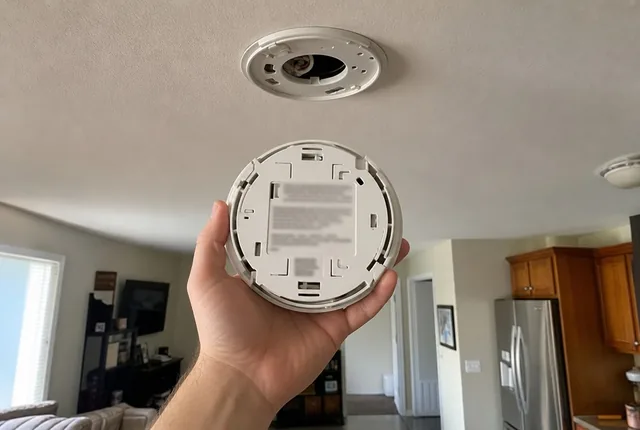
Take it down and look at the back: the date it was made is printed there. Add 10 years to get the replace-by date. If there is no date at all, treat it as due.
Source: NFPA, smoke alarms, checked October 8, 2026; USFA, smoke alarms, checked October 8, 2026.
How often should I change smoke detector batteries?
At least once a year for alarms with a replaceable battery, and right away if one chirps. Alarms with a sealed 10-year battery never get a new battery; a low-battery chirp means the whole alarm is due.
Source: NFPA, installing and maintaining smoke alarms, checked October 15, 2026.
Can a smoke alarm and a CO alarm share a spot?
In this count, every CO spot is also a smoke spot: the halls outside the bedrooms and the levels without bedrooms. If you use combination smoke and CO alarms, they go there, and smoke-only alarms go in the bedrooms. Follow each alarm's instructions for the mounting height.
Source: NFPA, carbon monoxide safety, checked October 15, 2026.
Part of a system
This page is one part of a bigger job. The system page puts the parts in order.
 SystemMonthly house checkOne page for the monthly house check: test each smoke and CO alarm, look at the filter, read the water meter, check under the sinks, write one line.8 steps · 7 parts · 1 page to printOpen the system
 SystemSmoke and CO alarm record: dates, batteries and the monthly testNumber every smoke and CO alarm, read the date on the back, note the battery type, then test once a month and tick it off on one printable record.8 steps · 3 parts · 1 page to printOpen the system
 SystemSpring home checklist and leak-check recordThe spring list for a US home on one printable page: book the cooling check-up, date and test every alarm, check the filter, run the two-hour leak check.9 steps · 6 parts · 1 page to printOpen the system
 SystemStorm and outage prep recordOne record for the next storm: count water and food by people and days, list what needs power, write contacts on paper, date the kit and check it yearly.9 steps · 5 parts · 1 page to printOpen the system
Guides that go deeper
 Know-howHow old is my smoke alarm? Reading the date on the backTake it down, find the date of manufacture on the back and add 10 years. What to do with no date, sealed batteries and CO alarms.Read the guide
 Practical noteHow to test smoke and CO alarms room by room, once a monthPress each test button on a fixed route, listen for the loud beep and write the date in the log. What a chirp means, plus the yearly battery job.Read the guide
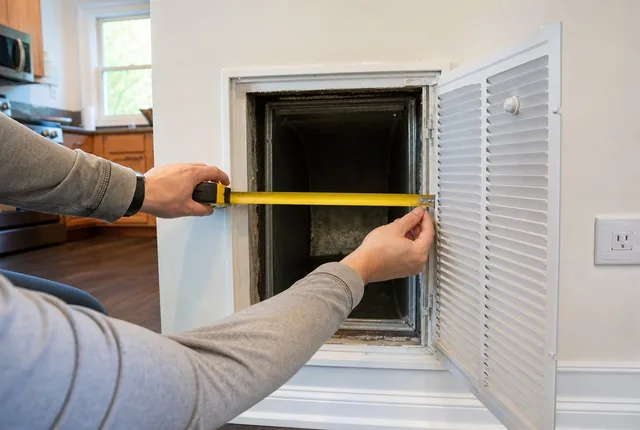 ProblemNo size printed on my air filter: how to find itThe print on the frame is gone or the slot is empty. Measure the opening, round to the nearest inch, and know when you need a custom size.Read the guide
Related tools
 Chapter 05Home maintenance calendarPick your climate region, say whether you own or rent and tick what the house has. Get a year of household jobs by month and a year sheet to print.Open the tool
 Chapter 04Move-in photo packetTurn your rental's rooms into a numbered photo list and a condition sheet you can print. Walls, floors, fixtures and appliances, room by room.Open the tool
 Chapter 01Appliance and warranty logRecord each appliance's model number, serial number and purchase date, see which warranty ends next, and print a one-page log for the drawer.Open the tool
 Chapter 01Home inventory sheetList what you own room by room, with what you paid, serial numbers and which items have a photo. See each room's total and print a one-page sheet.Open the tool
 Chapter 01HVAC filter size finder and replacement plannerTurn a nominal size like 16x25x1 into the filter's actual dimensions, or measure an old filter to find the size to buy, then plan the next change.Open the tool
- Chapter 05Outage supply plannerCount the water, food and flashlights for a home supply and a go-bag from the Ready.gov and Red Cross lists, with refill dates and a printable supply list.Open the tool
- Chapter 01All records toolsPrintable home records with a calculator behind each one: appliance and warranty log, HVAC filter sizes and change dates.Open the chapter
Sources
- Installing and maintaining smoke alarms, National Fire Protection Association (NFPA). Checked October 15, 2026.
- Carbon monoxide safety, National Fire Protection Association (NFPA). Checked October 15, 2026.
- Smoke alarms, National Fire Protection Association (NFPA). Checked October 8, 2026.
- Smoke alarms, U.S. Fire Administration (FEMA). Checked October 8, 2026.
See every source on the site on the sources page. Spotted an error? Tell us.