Chapter 01Records · Practical note
How to test smoke and CO alarms room by room, once a month
Walk the same route every month, top floor to basement, and press the test button on each smoke and CO alarm. NFPA says to test at least once a month; a working smoke alarm answers with a loud beep, beep, beep. If one stays quiet, change its battery, or replace the whole alarm if it's more than 10 years old. Write the date and the result in the log before you move on.
Source: NFPA, installing and maintaining smoke alarms, checked October 15, 2026; NFPA, smoke alarms, checked October 8, 2026; NFPA, carbon monoxide safety, checked October 15, 2026.
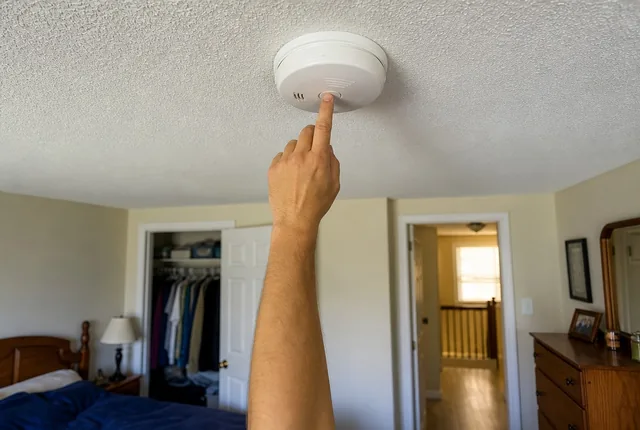
- Test button on every smoke and CO alarm (NFPA)Monthly NFPA, installing and maintaining smoke alarms, October 15, 2026; NFPA, carbon monoxide safety, October 15, 2026
- A single chirp at this gap means a low battery30 or 60 s NFPA, smoke alarms, October 8, 2026
- New battery in alarms with a replaceable one1 a year NFPA, installing and maintaining smoke alarms, October 15, 2026
Why a route and a log
It's easy to test the alarm you can reach and forget the one over the basement stairs. A fixed route means every alarm gets pressed, and a log tells you in March whether February's test happened.
Before the first test
Number the alarms
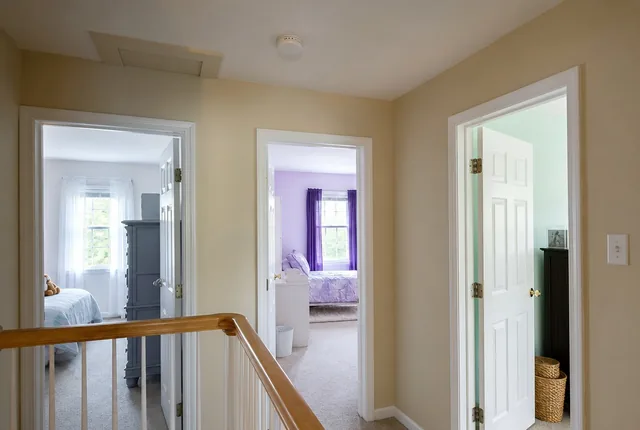
Walk the house once and give each alarm a number and a place: 1 main bedroom, 2 hall outside the bedrooms, and so on. The planner lists every spot NFPA counts, so you can check none is missing.
Tell the house
Warn everyone, and the dog, before you start. The test is loud on purpose.
Find the test button
It's the button on the face of the alarm. On a combination smoke and CO alarm, check the label for what the button tests.
Print the log
Print the alarm test log from the planner. Keep it with the house records, or tape it inside a closet door near the stairs.
Source: NFPA, installing and maintaining smoke alarms, checked October 15, 2026.
Let the tool do the arithmeticSmoke and CO alarm plannerCount the alarms level by level first. The planner lists each spot with its replace-by date and prints the monthly test log.Example: 7 smoke, 3 CO alarms (3 levels, 4 bedrooms)Open the toolThe monthly test, alarm by alarm
Start at the top
Start on the top floor and work down, so you finish at the basement alarm at the bottom of the stairs.
Press the button once
A working smoke alarm answers with a loud beep, beep, beep.
Listen for the others
If your alarms are interconnected, USFA says they all sound when one does. Have someone listen at the far end of the house.
Write it down
Date, alarm number, OK or not. One line per alarm.
Do the CO alarms the same day
NFPA says to test carbon monoxide alarms at least once a month too, so they go on the same route.
Source: NFPA, installing and maintaining smoke alarms, checked October 15, 2026; NFPA, smoke alarms, checked October 8, 2026; USFA, smoke alarms, checked October 8, 2026; NFPA, carbon monoxide safety, checked October 15, 2026.
What the sounds mean
- Loud beep, beep, beep when you press the button: the alarm passed this month's test.
- Nothing when you press the button: change the battery, or replace the whole alarm if it's more than 10 years old.
- A single chirp every 30 or 60 seconds: the battery is low. Change it the same day instead of waiting for the next test.
- Chirping that carries on after a new battery: the alarm has reached the end of its life and needs replacing.
- A chirp from an alarm with a sealed 10-year battery: there's no battery to change, so NFPA says to replace the whole alarm.
Source: NFPA, smoke alarms, checked October 8, 2026; NFPA, installing and maintaining smoke alarms, checked October 15, 2026.
A test is not an alarm
If an alarm goes off and nobody pressed a button, this checklist stops there. Follow the fire department's guidance for a real alarm on the USFA smoke alarm page.
Once a year
Pick one test each year to do more than press buttons. Change the battery in every alarm that takes a replaceable one, as NFPA advises, using the battery type listed on the back of the alarm. While it's down, read the date of manufacture and check it against the 10-year mark. The guide to reading the date on the back shows where to look.
Source: NFPA, installing and maintaining smoke alarms, checked October 15, 2026; USFA, Don't wait, check the date handout, checked October 12, 2026.
Tie the battery day to the clock change
Pick the fall clock change, or any date you already keep, for the yearly battery job and write it in the log's yearly row.
Checklist to print
Tick these off each month:
- Everyone in the house warned before the test
- Top floor alarms pressed and heard
- Bedroom alarms pressed and heard
- Hall alarms outside the bedrooms pressed and heard
- Main floor and basement alarms pressed and heard
- CO alarms tested the same day
- Interconnected alarms all sounded together
- Any quiet alarm: battery changed or alarm replaced
- Any chirp: battery changed the same day
- Date and result written in the log
Tips and tricks
- Tip 01
Use a broom handle
If the alarm is high, press the test button with the end of a broom handle instead of climbing. Keep the step stool for the yearly battery change.
- Tip 02
Write the date on new alarms
Before a new alarm goes up, write its replace-by date on the side of the base: 10 years from the date printed on the back.
Source: USFA, Don't wait, check the date handout, checked October 12, 2026.
- Tip 03
Keep spare batteries with the log
Buy the battery type printed on the back of your alarms and keep two with the log, so a chirp at 3 a.m. doesn't mean a trip to the store.
Source: NFPA, installing and maintaining smoke alarms, checked October 15, 2026.
- Tip 04
Test after work near an alarm
After painting, fitting a ceiling fan or sanding drywall near an alarm, press the test button. NFPA says never to paint an alarm.
Source: NFPA, installing and maintaining smoke alarms, checked October 15, 2026.
- Tip 05
Tick the log even for an OK
A blank row means the test didn't happen.
What we would do
Pick a day and a route this week
Number the alarms with the planner, print the log and do the first test this weekend, top floor down. After that, test on the same day each month, say the first Saturday, and change the replaceable batteries once a year.
Source: NFPA, installing and maintaining smoke alarms, checked October 15, 2026.
Questions
How often should you test smoke alarms?
At least once a month with the test button, NFPA says. CO alarms get the same monthly test.
Source: NFPA, installing and maintaining smoke alarms, checked October 15, 2026; NFPA, carbon monoxide safety, checked October 15, 2026.
How do I test a smoke detector?
Press the test button once and listen for a loud beep, beep, beep. If it stays quiet, change the battery, or replace the alarm if it's more than 10 years old.
Source: NFPA, smoke alarms, checked October 8, 2026.
Why is my smoke alarm chirping?
A single chirp every 30 or 60 seconds means the battery is low. If it keeps chirping after a new battery, the alarm is at the end of its life and needs replacing.
Source: NFPA, smoke alarms, checked October 8, 2026.
Do hard-wired smoke alarms need testing too?
Yes. NFPA's monthly test-button routine covers every smoke alarm. Replacing a hard-wired alarm is wiring work: switch off and isolate the supply, check it's dead with a tester, follow local wiring rules, and use a licensed electrician where the law requires one.
Source: NFPA, installing and maintaining smoke alarms, checked October 15, 2026.
Should I keep a smoke alarm test log?
A log is how you know a test happened. Write one line per alarm each month: the date, the alarm number and OK or not. The smoke and CO alarm planner prints one.
Part of a system
This page is one part of a bigger job. The system page puts the parts in order.
 SystemMonthly house checkOne page for the monthly house check: test each smoke and CO alarm, look at the filter, read the water meter, check under the sinks, write one line.8 steps · 7 parts · 1 page to printOpen the system
 SystemSmoke and CO alarm record: dates, batteries and the monthly testNumber every smoke and CO alarm, read the date on the back, note the battery type, then test once a month and tick it off on one printable record.8 steps · 3 parts · 1 page to printOpen the system
The tool and more guides
 Chapter 01Smoke and CO alarm plannerCount smoke and CO alarms level by level from NFPA's placement list, then get the replace-by date and the next battery change for your alarms.Open the tool
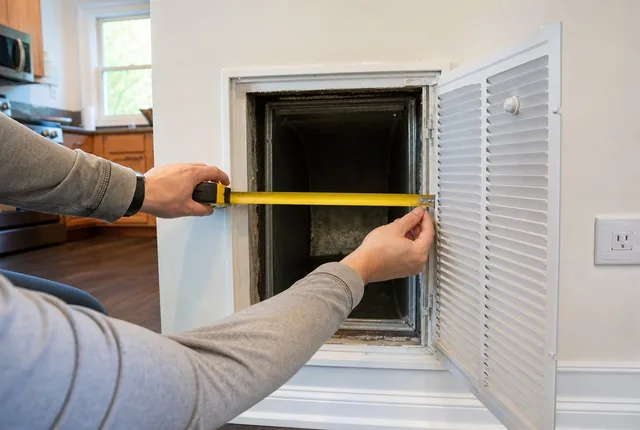 ProblemNo size printed on my air filter: how to find itThe print on the frame is gone or the slot is empty. Measure the opening, round to the nearest inch, and know when you need a custom size.Read the guide
 Practical noteWhat to change on move-in day: locks, garage opener and codesNew house, old keys. Here's the order to work in on move-in week: count what you got, change the locks, clear the garage opener, reset codes, then cut copies.Read the guide
- Chapter 01All records toolsPrintable home records with a calculator behind each one: appliance and warranty log, HVAC filter sizes and change dates.Open the chapter
Sources
- Installing and maintaining smoke alarms, National Fire Protection Association (NFPA). Checked October 15, 2026.
- Smoke alarms, National Fire Protection Association (NFPA). Checked October 8, 2026.
- Carbon monoxide safety, National Fire Protection Association (NFPA). Checked October 15, 2026.
- Smoke alarms, U.S. Fire Administration (FEMA). Checked October 8, 2026.
- Don't Wait, Check the Date! Replace smoke alarms every 10 years, U.S. Fire Administration (FEMA). Checked October 12, 2026.
Every outside number on this page names its source and the date we checked it. See them all on the sources page. Spotted an error? Tell us.