Chapter 04Moving · Practical note
How to fill in a move-in condition checklist
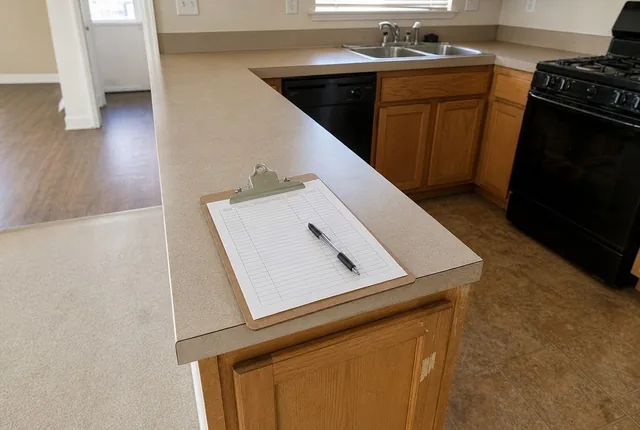
Fill in every row as you walk, even the clean ones. Circle one letter: G for good, W for worn, D for damaged or M for missing. Then write what you see, where it is from a fixed point, how big it is and how many, and the photo number. Write NA for anything the home doesn't have. Make two copies, and write down the date and how you handed the landlord theirs.
Source: DC DDS, Tenant Move-In/Move-Out Checklist, checked October 10, 2026; The Fair Housing Center, Tenant Move-In and Move-Out Checklist, checked October 10, 2026.
- G good, W worn, D damaged, M missing: one per row4 letters Arithmetic from the figures on this page
- One for the landlord, one you keep (Toledo form)2 copies The Fair Housing Center, Tenant Move-In and Move-Out Checklist, October 10, 2026
- For any item the home doesn't have (DC form)NA DC DDS, Tenant Move-In/Move-Out Checklist, October 10, 2026
Who the sheet is for
You write the sheet on move-in day, but the person who reads it might be you in a year, a new property manager, or someone who has never been inside the apartment. Write every note so it still makes sense to that person without you there to explain.
One row at a time
Circle one letter
G good, W worn, D damaged, M missing. If you can't decide between two, circle the worse one and say why in the note.
Say what it is
Name the thing you see: stain, scratch, chip, crack, hole, burn, dent, rust, loose, missing. Add the color if it helps, like a brown stain or a white scuff.
Say how big and how many
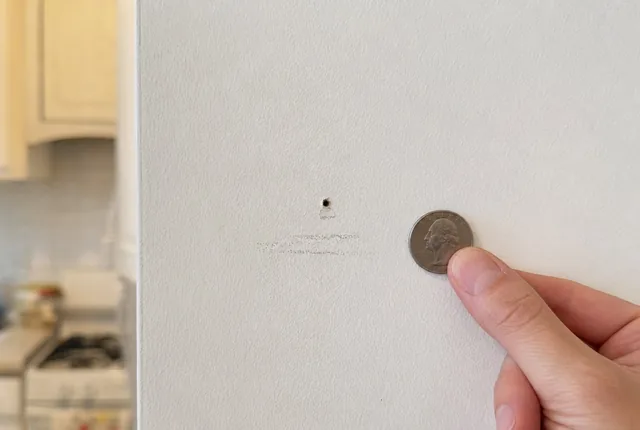
Measure or compare: about 3 inches across, the size of a quarter, two holes, three scratches. A count and a size beat "some" and "small".
Say where, from a fixed point
Start from something that won't move: 2 feet inside the door, left of the sink, above the light switch, the corner by the window.
Add the photo number
Write the number of the close-up, and of any extra photo you took. Put "no photo" if there isn't one, so nobody goes looking.
A real example from a published form
The DC checklist shows how to fill a row with a walls entry that reads "Dirty and hole in kitchen wall by pantry" and Pictures marked Yes. It says what, and where from a fixed point. Add a size and a photo number and it's complete.
Source: DC DDS, Tenant Move-In/Move-Out Checklist, checked October 10, 2026.
Words that work and words that don't
- "OK", "fine" or "normal": say what you checked instead. "Clean, no marks" or "all four burners light" tells the reader what you looked at.
- "Some", "a few", "small": swap in a count and a size.
- "Damaged" on its own: name the damage. A crack and a chip are different things.
- "Old" or "dated": that's an opinion. Describe what you see, like "faded, yellowed at the edges".
- Arrows and private shorthand: spell it out. The reader won't know what "L of DW" means. "Left of the dishwasher" is clear to anyone.
Rows the home doesn't have, and rows you can't check
If an item isn't in the home, the DC form says to write NA in the box. A blank row looks like you skipped it. If something is there but you couldn't check it, say so, like "dishwasher not run" or "window painted shut, not opened". This sheet records condition only. It doesn't judge whether anything is safe or works properly.
Source: DC DDS, Tenant Move-In/Move-Out Checklist, checked October 10, 2026.
When the landlord's form uses numbers
Some forms score each item instead of using letters. The Toledo form runs from 1 for severe damage to 5 for brand new. Fill in their scale on their form, and copy your photo numbers and notes next to each line so both papers say the same thing.
Source: The Fair Housing Center, Tenant Move-In and Move-Out Checklist, checked October 10, 2026.
Finishing the sheet
Number the pages
Write page numbers and add extra pages for anything that didn't fit. The Toledo form asks for this, and for printed photos to go with it.
Initials and signatures
The DC form has the landlord initial every page and both of you date and sign the last one. If your landlord's form has spaces like that, fill them in on the day.
Two matching copies
Fill in two copies the same way, one for the landlord and one to keep, as the Toledo form says. A photo or scan of the signed pages works as your copy too.
Write how it was handed over
Note the date, how the landlord's copy went (in person, drop box or mail) and who took it.
Source: The Fair Housing Center, Tenant Move-In and Move-Out Checklist, checked October 10, 2026; DC DDS, Tenant Move-In/Move-Out Checklist, checked October 10, 2026.
This is a record, not advice
The sheet says what you saw and when. What a landlord may charge for, what counts as normal wear and what your state's law requires are questions for a local tenant union, a legal aid office or your state's housing agency.
Checklist to print
Before you hand it over, check:
- Every row has one letter circled
- Each mark says what, where and how big
- Photo number on every row, or "no photo"
- NA on items the home doesn't have
- Anything not checked says so
- Pages numbered, extra pages attached
- Landlord initials and both signatures where the form asks
- Two matching copies made
- Hand-over date, method and person written down
- Your copy filed with the photos
Tips and tricks
- Tip 01
Use a pen, not a pencil
Pencil smudges and can be erased. If you make a mistake, cross it out with one line and initial it.
- Tip 02
Write in the room
Fill in each row while you're standing in front of the item, not from the photos that evening.
- Tip 03
Leave the move-out column blank
It's for the day you leave. Use the same sheet so each move-out note sits beside its move-in note.
- Tip 04
Keep the sheet with the photos
Scan or photograph the finished pages and save them in the same folder as the move-in photos.
Source: Mohave County (AZ), Checklist for Walk-Through Inspection (Form A), checked October 10, 2026.
What we would do
Print your packet and fill it in on the walk
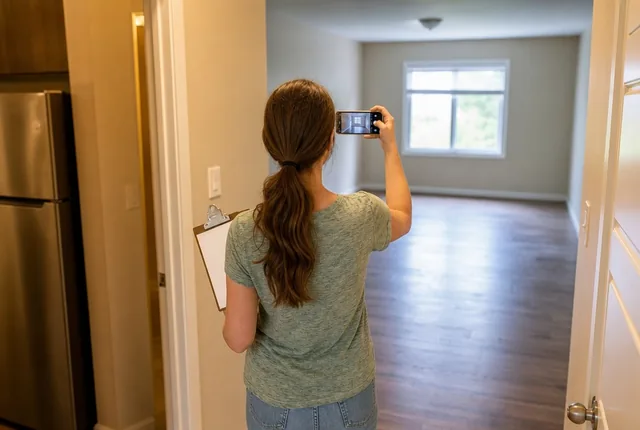
Print the condition sheet from the photo packet, take a pen and a coin, and fill in each row as you take its photo. Make your copy before you hand the landlord theirs, and write down how and when it went.
Questions
What do I write on a move-in checklist?
For each item, the condition, then what you see, where it is and how big it is, plus the photo number. "Brown stain about 3 inches across, 2 feet inside the bedroom door, photo 37" is a complete note.
What do G, W, D and M mean on the condition sheet?
Good, worn, damaged and missing. Circle one per row and explain anything other than G in the note.
What if an item isn't in the apartment?
Write NA, as the DC form says. A blank box looks like a skipped row.
Source: DC DDS, Tenant Move-In/Move-Out Checklist, checked October 10, 2026.
Should I write notes for things in good condition?
A short one, yes: "clean, no marks" or "no chips". It shows you looked, and it's what you compare against at move-out.
How many copies of the move-in checklist should I make?
Two matching copies, one for the landlord and one you keep, as the Toledo form says. Write down the date and how the landlord's copy was handed over.
Source: The Fair Housing Center, Tenant Move-In and Move-Out Checklist, checked October 10, 2026.
Part of a system
This page is one part of a bigger job. The system page puts the parts in order.
The tool and more guides
 Chapter 04Move-in photo packetTurn your rental's rooms into a numbered photo list and a condition sheet you can print. Walls, floors, fixtures and appliances, room by room.Open the tool
 Know-howMeter readings to record on move dayRead and photograph the electric, gas and water meters at the home you leave and the one you move into. How digital and dial meters read, and what to write.Read the guide
 Know-howWhat to photograph on move-in day, room by roomThe shot list for an empty rental: wide photos from each corner, then one close-up per item, numbered in walking order so the sheet and your phone agree.Read the guide
- Chapter 04All moving toolsMoving tools with a printable sheet behind each one: a numbered move-in photo list, a condition sheet for renters, and the dates to call each utility.Open the chapter
Sources
- Tenant Move-In/Move-Out Checklist, DC Department on Disability Services (DDS). Checked October 10, 2026.
- Tenant Move-In and Move-Out Checklist, The Fair Housing Center (Toledo, Ohio). Checked October 10, 2026.
- Checklist for Walk-Through Inspection (Form A), Mohave County, Arizona. Checked October 10, 2026.
Every outside number on this page names its source and the date we checked it. See them all on the sources page. Spotted an error? Tell us.